
What Is a PLC and Why Quality PLC Programming Is Critical
If you’ve ever walked through a manufacturing facility and seen a machine come to life at the push of a button, chances are a PLC (Programmable Logic Controller) was behind the scenes making it all happen. Think of a PLC as the brain of an automated system—taking in inputs, making decisions based on logic, and then triggering outputs that control everything from motors and valves to lights and sensors (and more).
At the heart of every modern automated system lies a Programmable Logic Controller—a rugged, industrial digital computer used to control electromechanical processes. Whether it’s a conveyor line, packaging system, or robotic work cell, the PLC is the system’s decision-maker. It continuously monitors input, executes logical instructions in real time, and sends commands to outputs that control machinery.
But the real power of a PLC isn’t just in the hardware. It’s in the programming—and that’s where expertise makes all the difference.
 At Live Automation (LIVE), we live and breathe this stuff. (Seriously, our phone number is 866-PLC-GUYS for a reason.) We’ve spent over two decades engineering high-performance control systems across virtually every major industrial platform. Our PLC solutions drive efficiency, reliability, and safety—by design.
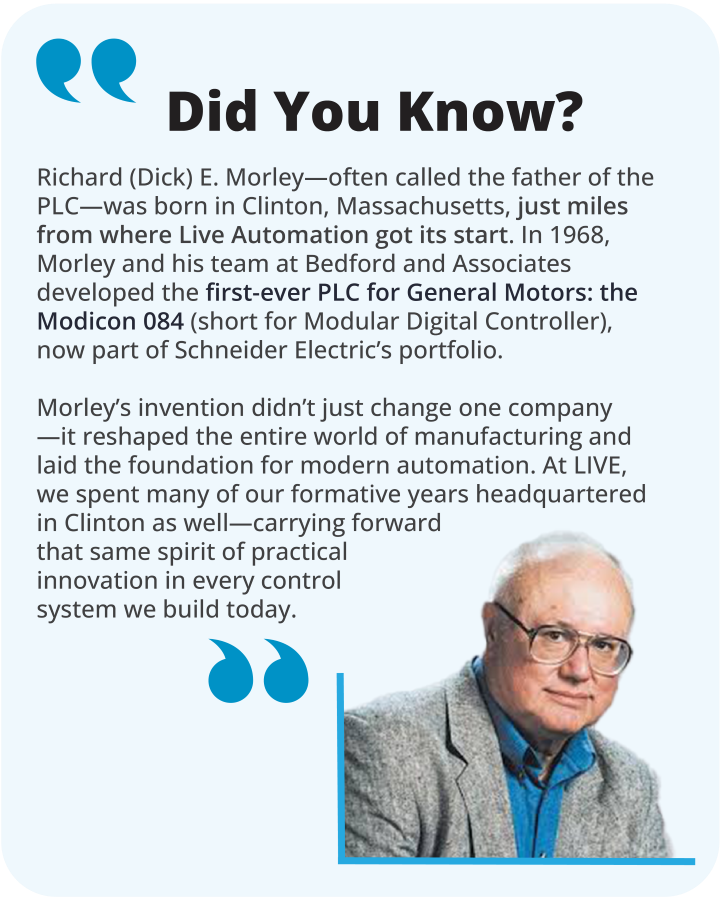
In fact, our own roots trace back to Clinton, Massachusetts—the same small town where Richard (Dick) E. Morley, widely considered the “father of the PLC,” was born. Morley’s groundbreaking work at Bedford and Associates led to the development of the very first PLC in 1968—the Modicon (now owned by Schneider Electric)—for General Motors. That invention didn’t just change manufacturing; it shaped the very foundation of modern automation. When we launched Live Automation in Clinton years later, we did so in the shadow of that legacy, inspired by the same spirit of practical innovation. Today, we carry that legacy forward in Sterling, MA—building intelligent control systems that continue to push automation forward.
So…What Exactly Is a PLC?
A PLC is an industrial-grade computer that’s designed to operate in harsh industrial environments and run machine processes 24/7. Unlike a regular computer, a PLC is built to handle real-world conditions such as electrical noise, extreme temperatures, humidity, and mechanical vibration.
But what makes a PLC so powerful is its ability to be programmed. With the right logic in place, a PLC can automate virtually any mechanical or electrical process consistently, reliably, and with minimal human intervention.
It’s engineered for deterministic behavior, meaning it scans and executes operations in a predictable loop. Here’s a simplified version of a standard PLC scan cycle:
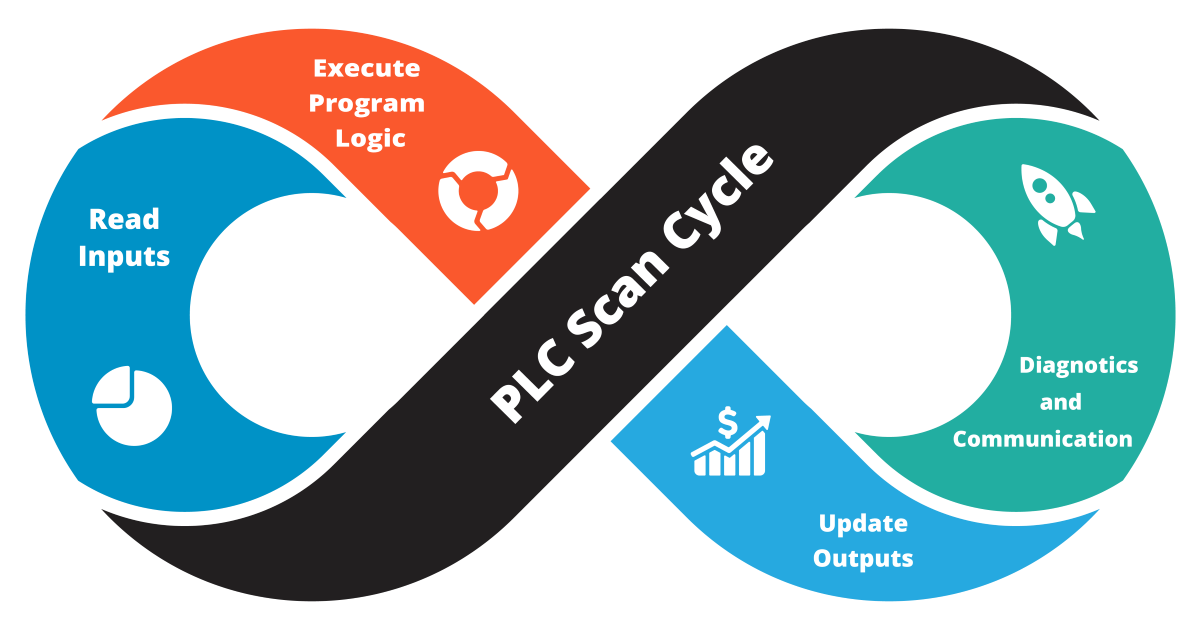
The PLC Scan Cycle
Today’s PLCs can execute this loop in less than a millisecond, allowing for high-speed, real-time control. Each scan includes:
Read Inputs: The PLC begins its scan cycle by capturing the current state of all input devices (sensors, switches, and analog signals, etc). These values are stored in memory and used to evaluate the control logic during this cycle.
Executed Logic: This is where decisions are made. If conditions are true, outputs are triggered, or processes are initiated. Using the most recent input values, the PLC executes the programmed instructions using IEC 61131-3 programming languages (ladder logic, structured text, function blocks, etc.).
Updated Outputs: Based on the logic execution results, the PLC updates the state of its outputs, energizing outputs and performing actions such as turning on motors, opening valves, activating alarms, and/or communicating with other devices as needed. The output state remains fixed until the next cycle.
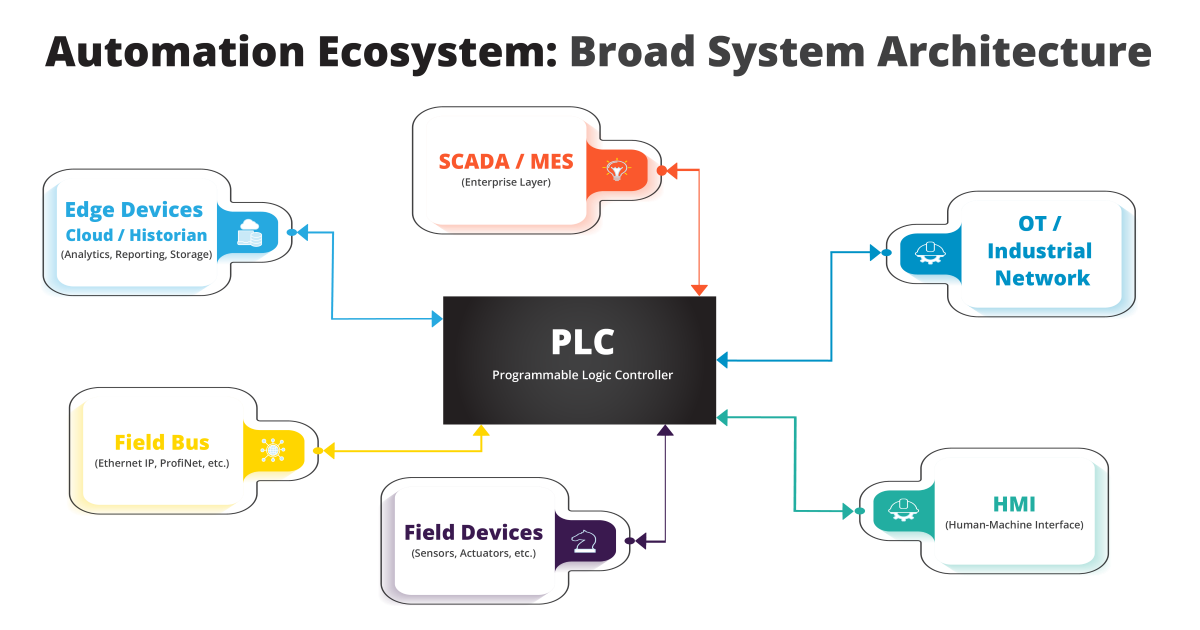
Diagnostics & Communication: During this final phase of the cycle, the PLC handles internal system checks and external communication—such as sending data to an HMI, SCADA, or MES system. It ensures system health, reports faults, and syncs with the broader control architecture.
Why Does PLC Programming Quality Matter?
Programming a PLC is how we give machines their marching orders. It’s what turns a motor on at the exact right time, ensures safety interlocks trigger as needed, and coordinates hundreds of steps into a seamless production cycle.
A well-selected PLC is only as effective as its programming. Poorly structured or undocumented code can lead to erratic machine behavior, excessive downtime, or dangerous failures. That’s why good PLC programming isn’t just about getting machines to run—it’s about making them run reliably, predictably, and safely.
Here’s what high-quality PLC programming delivers:
Reliable Operation
Clean, well-documented code ensures predictable behavior and easier troubleshooting—saving hours during commissioning or service calls.
Scalability & Modularity
Reusable, modular code simplifies system expansion and integration of new devices—without rewriting everything from scratch.
Safety & Compliance
Whether you’re following ISO 13849, IEC 62061, or something else altogether, reliable PLC logic helps you meet safety standards and ensure traceability.
Real-Time Diagnostics
Advanced error handling, alarm management, and system monitoring features reduce downtime, improving response time and OEE (Overall Equipment Effectiveness).
Efficient Integration
Quality logic supports seamless communication with SCADA, MES, robotics, VFDs, and IIoT platforms—creating a more intelligent system architecture.
Why It Matters to Your Bottom Line
Poorly written PLC code shows up on your floor as inefficiencies, breakdowns, and troubleshooting headaches. Good code prevents those issues. It keeps machines humming, operators confident, and your team focused on output—not problem-solving.
We’ve seen what happens when programming is treated as an afterthought. Our job is to make sure your systems not only work—but work better, smarter, and more sustainably.
Our Expertise at Live Automation
At Live Automation, our PLC programming services go far beyond the basics. Our engineers work directly with your team to develop logic that fits your operation—not just the textbook version. We specialize in:
- Custom PLC/HMI control system development
- Legacy code conversion and upgrades
- SLC / PLC-5 to CompactLogix / ControlLogix
- Siemens S5 to S7-1500
- Your PLC to the latest and greatest
- Servo & Motion integration
- Seamless communication between systems (HMI, SCADA, MES, etc.)
- Remote access and IIoT-ready systems
- Advanced data logging, trending, and analysis tools
- Industry-specific implementations (e.g., Medical, Food & Bev, Packaging, General Industrial, and more)
If a machine has logic behind it, we can build it, fix it, or optimize it. That’s why our clients—from lean startups to Fortune 500 manufacturers—trust us to get their systems running efficiently and reliably. Every system we deliver is fully documented, tested, and optimized for long-term performance—because when you call the PLC guys, you expect it done right.
Thinking About Upgrading or Troubleshooting a PLC?
We often recommend a PLC system audit for companies running legacy systems or dealing with inconsistent machine behavior. Our complimentary PLC analysis offers a technical review of your current codebase, hardware platform, and integration opportunities.
Our engineers are fluent in all major PLC platforms, from Allen-Bradley/Rockwell Automation and Siemens to Mitsubishi, Omron, Schneider Electric, and many more. Whether you’re launching a new automation project, looking to upgrade outdated systems, or just need someone to take a look under the hood, we’re here to help.
Final Word: Why Work With LIVE?
There are plenty of folks who can wire up a PLC. But getting the logic right—and futureproofing your system—takes a different level of expertise. At Live Automation, we bring that expertise to every build, retrofit, or debug session we take on.
Need support? Looking for a fresh start?
Give us a call at (866) PLC-GUYS—or reach out here.
We’re ready to dive in.